---
title: "Search Abandonment: The $2 trillion gap threatening your e-commerce business"
description: 94% of consumers receive irrelevant results. Learn what search abandonment is, how to measure it, and how to turn it into a growth driver for your e-commerce business.
image: https://blog.sensefuel.com/hubfs/iStock-1329553238%20(1)-1.jpg
---
- [English](https://blog.sensefuel.com/en/search-abandonment-the-2-trillion-gap-threatening-your-e-commerce-business)
- [Français](https://blog.sensefuel.com/search-abandonment-le-gouffre-à-2-000-milliards-de-dollars-qui-menace-votre-e-commerce)
English
Show submenu for translations
[](https://www.sensefuel.com/en/)
- [Product](https://www.sensefuel.com/en/platform/tour)
- [Integration](https://www.sensefuel.com/en/deploy/get-started-in-no-time/)
- [Pricing](https://www.sensefuel.com/en/products-plans/)
- [Use case](https://www.sensefuel.com/en/use-case/)
- [Resources](https://www.sensefuel.com/en/resources/)
Open main navigation
Close main navigation
- [Product](https://www.sensefuel.com/en/platform/tour)
- [Integration](https://www.sensefuel.com/en/deploy/get-started-in-no-time/)
- [Pricing](https://www.sensefuel.com/en/products-plans/)
- [Use case](https://www.sensefuel.com/en/use-case/)
- [Resources](https://www.sensefuel.com/en/resources/)
- - [English](https://blog.sensefuel.com/en/search-abandonment-the-2-trillion-gap-threatening-your-e-commerce-business)
- [Français](https://blog.sensefuel.com/search-abandonment-le-gouffre-à-2-000-milliards-de-dollars-qui-menace-votre-e-commerce)
English
Show submenu for translations
- [Contact](https://info.sensefuel.com/en/request-information-new)
[Contact](https://info.sensefuel.com/en/request-information-new?hsLang=en)
[Back to the blog](https://blog.sensefuel.com/en)
[E-commerce / Retail](https://blog.sensefuel.com/en/tag/e-commerce-retail)
# Search Abandonment: The $2 trillion gap threatening your e-commerce business
-1.jpg)
You optimize your payment funnel, your ads, your SEO/GEO, but did you know that an invisible flaw in your search bar costs global e-merchants more than $2 trillion a year?
This phenomenon, known as Search Abandonment, occurs when your most qualified customer, the one who knows exactly what they want, cannot find a relevant answer and leaves your site.
## **1. The search bar paradox: the favorite tool, but also the most disappointing **
Sensefuel's [survey of product search habits on e-commerce websites 2026 edition](https://info.sensefuel.com/en/survey-of-product-search-habits-on-e-commerce-websites-2026-edition?hsLang=en) shows that the search bar has become the primary entry point for shoppers.
- **First reflex: 68%** of consumers use the search bar to find a product.
- **Mobile dominance:** This figure rises to 70% for purchases made on smartphones.
- **High intent:** Search engines are used extensively once the intent becomes clear: **73%** of users use them to search for a specific product.
However, the Google study reveals a harsh reality: 94% of global consumers have received irrelevant results in the last 6 months.
## **2. The price of failure: 50% of your customers will leave you for the competition.**
Search abandonment is not just a technical problem; it is an immediate and lasting loss of customers.
- **This is immediately followed by a negative reaction**: According to Sensefuel's 2026 Survey, if the search engine does not return satisfactory results, **50% of users simply leave the website.**
- **Broken loyalty**: Google study confirms that **78% of shoppers now avoid sites where they have previously encountered search difficulties.**
- **Major frustrations**: Customers no longer tolerate “zero results” (**18%**) or a complete lack of tolerance for typing errors (**11%)**. A simple mismatch between the user's words and those on the site is enough to break the sale.
## **3. Search: The No. 1 driver of growth by sector**
Why is this so critical? Because your 'searchers' are your most profitable customers.[Sensefuel's data](https://www.sensefuel.com/en/sector/)
shows that the impact varies by sector, but remains vital everywhere:
| **Retail Segment** | Impact on performance | Specific behavior |
| --- | --- | --- |
| [Homeware & Furniture](https://www.sensefuel.com/en/sector/homeware-furniture/) | +176% conversion via search | Need clarification on styles and dimensions. |
| [**Consumer electronics & Specialty goods**](https://www.sensefuel.com/en/sector/consumer-electronics-specialty-goods/) | Ratio of 4.06 | A user who searches converts 4x more than one who browses. |
| [Consummer Goods](https://www.sensefuel.com/en/sector/Consumer-goods/) | 52% of revenue generated by search | The engine is the number one tool for fast racing. |
| [DIY & Garden](https://www.sensefuel.com/en/sector/diy-garden/) | +92% conversion via search | The management of technical synonyms is vital. |
| [**Fashion & Beauty**](https://www.sensefuel.com/en/sector/fashion-beauty/) | +49% conversion via search | 62% of customers expect personalization according to their tastes. |
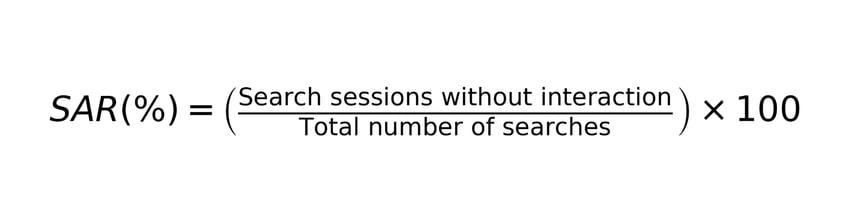
## **4. How to calculate and detect your Search Abandonment Rate (SAR)?**
To measure the extent of the problem, use this formula:
**Alerts to watch out for: :**
1. **The “Zero Results” rate**: Just one letter error and your product doesn't appear? That's a lost sale.
2. **Immediate exit**: The user does not click on any results, indicating that the results are not relevant.
3. **Lack of personalization**: **82%** of 18-34 year olds expect the site to understand their tastes and personalize the display.
## Conclusion: From browsing to intent
The days of asking customers to “dig through” menus and results pages are over. To capture growth in 2026, your site must be able to understand the real purchase intent behind each query and [hyper-personalize the first results displayed](https://www.sensefuel.com/en/personalization-e-commerce/). By immediately showing the product that matches the buyer's tastes and context, you eliminate friction.
But above all, success depends on a massive investment in relevance. A search engine that doesn't understand nuances, synonyms, or typos is a search engine that will drive your customers away.
Solutions exist to transform this cost center into a sales driver. By [using AI to predict preferences](https://www.sensefuel.com/en/platform/exclusive-core-ai/) without collecting personal data, a platform such as Sensefuel can plug the leak of search abandonment and maximize the value of each visit.
Sources: Google Cloud study “Retail Search Abandonment”; Sensefuel 2026 Survey Survey of product search habits; Sensefuel Industry Benchmarks.
[**Stéphane Vendramini**](https://blog.sensefuel.com/en/author/stéphane-vendramini) [Founder, Sensefuel](https://blog.sensefuel.com/en/author/stéphane-vendramini)
## Discover the impact of Sensefuel on your e-commerce site!
Do you want to offer captivating shopping experiences, tailored to the sensitivities and contexts of each visitor, to convert searches into sales?
Thanks to its search, recommendation and hyper-personalisation capabilities, Sensefuel can boost your performance and meet the growing expectations of your users.
[Get a demo](https://www.sensefuel.com/en/request-informations/)
Platform
- [A quick tour of the solution](https://www.sensefuel.com/en/platform/tour)
- [Why Sensefuel](https://www.sensefuel.com/en/platform/why-sensefuel)
- [Exclusive Core AI for eCommerce](https://www.sensefuel.com/en/platform/exclusive-core-ai)
- [API & Composable Architecture](https://www.sensefuel.com/en/platform/api-composable-architecture)
- [Products & Plans](https://www.sensefuel.com/en/platform/products-plans/)
- [Get started in no time](https://www.sensefuel.com/en/platform/get-started-in-no-time)
Retail Solutions
BY INDUSTRY
- [Fashion & Beauty](https://www.sensefuel.com/en/retail-solutions/category/fashion-beauty)
- [DIY & Garden](https://www.sensefuel.com/en/retail-solutions/category/diy-home-garden)
- [Homeware & Furniture](https://www.sensefuel.com/en/retail-solutions/category/homeware-furniture)
- [Consumer Goods](https://www.sensefuel.com/en/retail-solutions/category/Consumer-goods)
- [Consumer Electronics and Specialty Goods](https://www.sensefuel.com/en/retail-solutions/category/consumer-electronics-specialty-goods)
BY ROLE
- [E-commerce and merchandising teams](https://www.sensefuel.com/en/retail-solutions/role/e-commerce-merchandising-teams)
- [Developers and IT teams](https://www.sensefuel.com/en/retail-solutions/role/developers-it-teams)
- [Parners, Agencies and Integrators](https://www.sensefuel.com/en/retail-solutions/role/agencies-integrators)
Customers
- [Our customers](https://www.sensefuel.com/en/customers)
Resources
- [All resources](https://www.sensefuel.com/en/resources)
- [Blog](https://blog.sensefuel.com)
Company
- [About us](https://www.sensefuel.com/en/company)
Contact us
5 rue Hergé
59650 Villeneuve d'Ascq
[+33 9 72 80 47 27](tel:+33%209%2072%2080%2047%2027)
[contact@sensefuel.com](mailto:contact@sensefuel.com)
[Follow us on Twitter](https://twitter.com/sensefuel_fr) [Follow us on LinkedIn](https://www.linkedin.com/company/sensefuel/)
Legal
- [Legal notices](https://www.sensefuel.com/en/legal-notice)
- [Privacy Policy](https://www.sensefuel.com/en/privacy-policy)
- Manage cookies

```json
{
"@context" : "https://schema.org",
"@type" : "TechArticle",
"abstract" : "This article explores the massive financial impact of Search Abandonment. According to the 2026 Sensefuel Survey, 50% of shoppers leave a site if search results are irrelevant. The study breaks down conversion gains by sector, such as +176% in Homeware & Furniture.",
"author" : {
"@type" : "Person",
"jobTitle" : "Founder of Sensefuel",
"name" : "Stéphane Vendramini",
"url" : "https://www.linkedin.com/in/stephanevendramini/",
"worksFor" : {
"@type" : "Organization",
"name" : "Sensefuel"
}
},
"dateModified" : "2026-03-20T09:00:00+01:00",
"datePublished" : "2026-03-20T09:00:00+01:00",
"description" : "Search abandonment costs $2 trillion annually. Analysis of Google Cloud and Sensefuel 2026 Survey data on the impact of on-site search relevance.",
"headline" : "Search Abandonment: The $2 trillion gap threatening your e-commerce business",
"image" : "https://blog.sensefuel.com/hubfs/Pour%20Blog/search-abandonment-2-trillion-gap.jpg",
"inLanguage" : "en-US",
"keywords" : [ "Search Abandonment", "E-commerce Trends 2026", "Conversion Rate Optimization", "On-site Search Engine", "Search Relevance", "Artificial Intelligence", "Customer Experience" ],
"knowsAbout" : [ {
"@type" : "Thing",
"name" : "E-commerce",
"sameAs" : "https://en.wikipedia.org/wiki/E-commerce"
}, {
"@type" : "Thing",
"name" : "Site search",
"sameAs" : "https://en.wikipedia.org/wiki/Web_search_query"
}, {
"@type" : "Thing",
"name" : "Search Abandonment Rate (SAR)"
} ],
"mainEntityOfPage" : {
"@id" : "https://blog.sensefuel.com/en/search-abandonment-the-2-trillion-dollar-gap",
"@type" : "WebPage"
},
"mentions" : [ {
"@type" : "Organization",
"name" : "Google Cloud",
"sameAs" : "https://cloud.google.com/"
}, {
"@type" : "Organization",
"name" : "Sensefuel",
"sameAs" : "https://www.sensefuel.com"
} ],
"publisher" : {
"@type" : "Organization",
"address" : {
"@type" : "PostalAddress",
"addressCountry" : "FR",
"addressLocality" : "Villeneuve d'Ascq",
"postalCode" : "59650",
"streetAddress" : "5 rue Hergé"
},
"logo" : {
"@type" : "ImageObject",
"url" : "https://a.storyblok.com/f/275626/300x41/2a3310c2e7/sensefuel-logo.svg"
},
"name" : "Sensefuel"
}
}
```